Blog . 21-11-2023
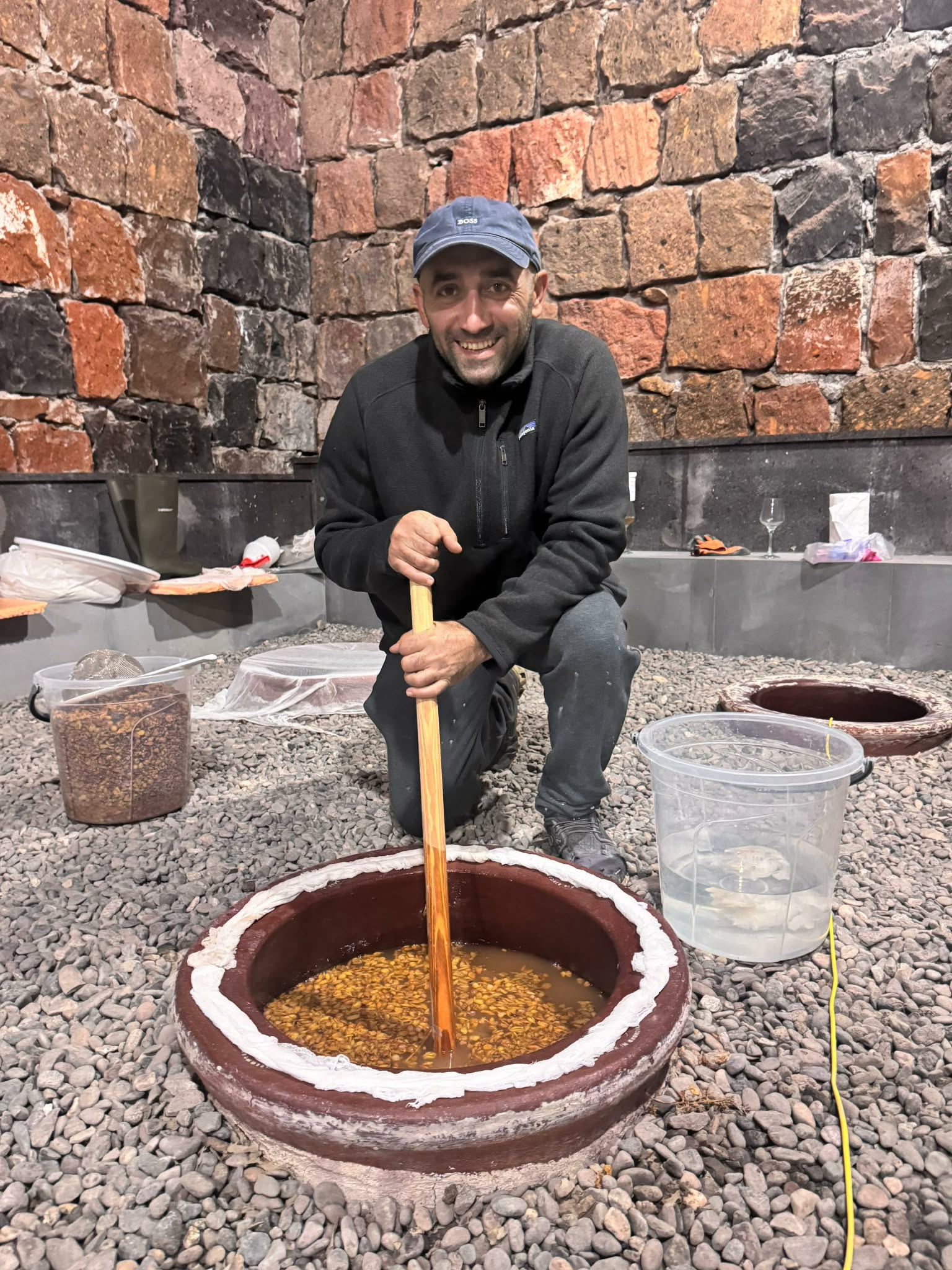
Khachik Gyurjyan – a natural wine producer in Armenia, with qvevris from Shrosha
This year’s Natural Wine Festival – ZERO COMPROMISE will be notable for the participation of a wine cellar from Armenia for the very first time. Before the festival, the Natural Wine Association inspected the cellar to ensure compliance. While foreign wineries traditionally take part in ZERO COMPROMISE, they usually represent established associations of natural wine producers in their respective countries. Armenia, however, has no such association. Therefore, it was necessary to inspect the cellar and vineyards of Gyurjyan Wines, which applied to participate in the festival.
Winemaker Khachik Gyurjyan is, if not the very first, then certainly among the earliest natural wine producers in Armenia. His cellar is located near Yerevan, in the Ararat region. For several years, he has been reconstructing an old Soviet farm building into a proper cellar — a project expected to take another two to three years to complete. Even now, however, the building already houses fermentation and storage sections, as well as a separate room for bottled wine.
Khachik Gyurjyan jokes that he is “from Gurjaani,” playing on the sound of his surname. For years, he has been devoted to reviving traditional Armenian winemaking, which involves fermenting wine in clay vessels of the qvevri type — known in Armenia as karas.
At present, no one in Armenia produces such clay vessels. As Gyurjyan explains, during the Soviet era the planned, centralized economy not only destroyed the production of these vessels but also nearly abolished Armenian winemaking altogether, reorganizing viticulture solely for the production of alcoholic beverages, especially Armenian cognac. Consequently, anyone wishing to make wine in Armenian karas must rely on old vessels. Gyurjyan initially did just that, fully aware of the risks: even thoroughly cleaned, old vessels can harbor wine diseases. Unfortunately, this is exactly what happened in his early attempts.
Afterward, Khachik Gyurjyan traveled to Shrosha, the historic center of Georgian pottery, where he purchased several qvevris from local potter Mamuka Mumladze. We saw these qvevris in Gyurjyan’s cellar, each bearing its own signature stamp and in excellent condition. We also tasted wine made from Armenian grape varieties fermented in them, which showed neither the so called “qvevri tone” nor any other distinctive qvevri-like flavor.
The inspection by the Natural Wine Association also included a visit to the vineyards. Unfortunately, due to bad weather, we were unable to see the two vineyards owned by Gyurjyan in the Ararat region, in the village of Verin Artashat. There he cultivates two Armenian grape varieties: Nerkarat (red) and Voskehat (white). From Voskehat grapes, Gyurjyan produces amber wine in qvevri, which we tasted in the cellar. It was a truly excellent example of classic amber wine.
The Association’s inspection team also visited vineyards managed by Gyurjyan in a completely different region — Vayots Dzor, specifically in the villages of Areni and Aghavnadzor, from which he annually sources grapes of the same varieties.
Areni is now a well known village where ancient winemaking centers have been discovered. In recent years, Armenian archaeologists made important finds in the famous Areni Cave, where millennia old wine vessels were unearthed. This discovery demonstrated that the technology and tradition of making wine in qvevri and similar vessels once extended beyond present day Georgia into neighboring regions. Of course, Georgia also boasts significant artifacts — such as the vessel discovered on Gadachrili Gora, containing grape remains and wine acid — which confirm that the oldest qvevri-type vessel used for wine from domesticated grapes was found there. Nevertheless, the archaeological discoveries in Areni have strengthened Armenian claims that the world’s oldest winemaking center lies in Armenia. Until scientists publish definitive conclusions, however, the “keyboard wars” between Armenian and Georgian ethnonationalists over who holds first place continue on social media. We will not elaborate further on these debates here.
We were deeply impressed by the old and newly planted vineyards in Areni and Aghavnadzor. This mountainous region, with vineyards at altitudes of around 1,000 meters above sea level, is home to diverse local grape varieties. The discoveries at Areni have accelerated viticulture in the area, and we observed many plots being prepared for new vineyard cultivation.
In the village of Areni, Khachik Gyurjyan collaborates with Avak and Mays Ghazaryan. Avak Ghazaryan, a hardworking farmer in his seventies, proudly notes that his ancestors also tended these vineyards, and his grandson is interested in continuing the tradition. We asked the three generations of Armenian winegrowers to pose for a photo together, but Avak’s grandson was too shy to join. The grape variety grown in the Ghazaryans’ vineyard is called Khachkharji, an indigenous white grape. In Armenian, khach means “cross,” giving the variety a distinctly religious motif.
We were even more impressed by the vineyards in Aghavnadzor (translated as Pigeon Valley), most of which are neither trellised nor trained on wires. Instead, they have been pruned for decades into small, tree like forms. During ripening, when the heavy grape clusters weigh down the vines, small stakes are still needed to prevent the fruit from touching the ground. As locals explained, this formation is linked to the hot climate: vines grow close to the soil to absorb as much moisture as possible, preventing them from withering.
In Aghavnadzor, Gyurjyan collaborates with Samvel Avakian, who proudly says his vineyard is already a hundred years old. This area, known as Khamer, is lined with vineyards once belonging to Soviet collective farms, now privatized and tended by individual growers. Avakian’s vineyard cultivates four indigenous grape varieties: Tchilar, Kharji, Khach Kharji, and Areni. The latter is a red grape, which Gyurjyan is not currently vinifying. Instead, he purchases grapes from the other three varieties and ferments them in qvevris. Avakian told us that in Aghavnadzor grapes must be harvested in autumn when the sugar content reaches 20–21, because otherwise bears descend from the mountains and devour the crop in a single night.
According to Gyurjyan, winegrowers in both Areni and Aghavnadzor mainly cultivate their vineyards organically, using contact preparations. The region’s hot climate typically requires two to three sprayings per season, with four to five only in rainy years. This provides favorable conditions for the development of organic and biodynamic viticulture.
As for natural wine, Gyurjyan worries that Soviet era inertia and stereotypes remain deeply rooted among Armenians, who often prefer locally produced or imported spirits over wine. Thus, natural wine production in Armenia is only just beginning. The few producers who have started this work do not yet know each other and have not formed any associations. For this reason, Gyurjyan asked the Georgian Natural Wine Association to allow him to participate in the Natural Wine Festival – ZERO COMPROMISE, so he could present his wines to Georgian and international merchants. The Association’s inspection visit concluded successfully, and therefore we will see Gyurjyan Wines represented at ZERO COMPROMISE.
Aleko Tskitishvili